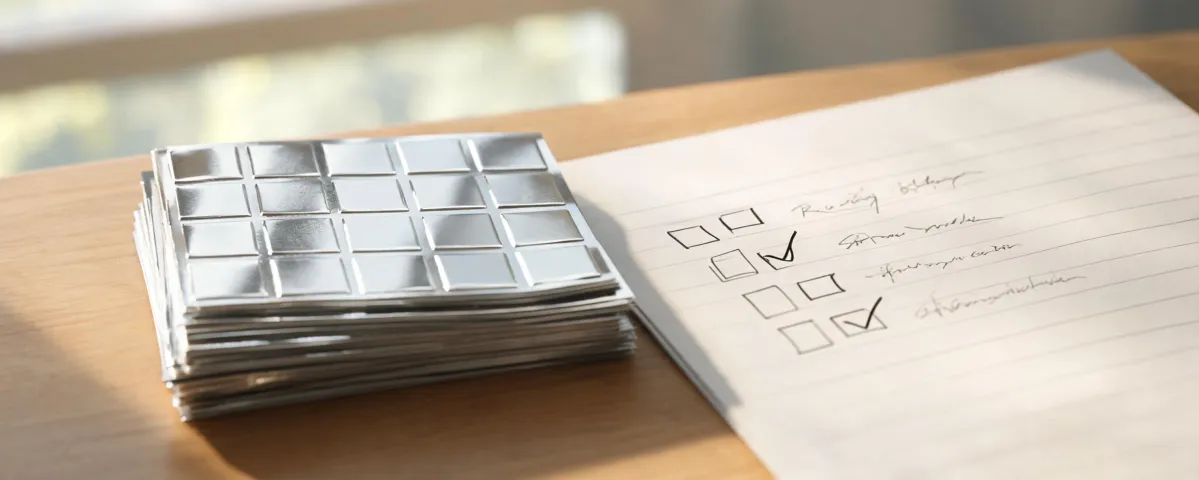
I think buying foil printed labels by lowest unit price is a fundamentally outdated strategy. Full stop. It didn't use to be wrong—the logic made sense when most label suppliers ran the same equipment and competed on similar terms. But the industry has shifted, and sourcing rules from five years ago don't reflect how things actually work in 2026.
I'm an office administrator at a 200-person company. I handle all the label and printing orders—roughly $120,000 annually across six vendors. I report to both operations and finance. When I took over purchasing in 2020, I had one goal: get the lowest per-thousand quote on every order. That worked fine until it didn't.
What a $3,000 mistake taught me about "cheap"
In March 2024, we switched our foil printed labels to a new online wholesaler. The price was way cheaper than our regular supplier—about $180 per thousand less. I was pretty proud of myself.
Three months later, product started coming back. The labels were lifting at the edges on our body wash bottles, especially on the ones sitting in bathroom conditions. The foil looked fine—it was the adhesive undercoat that gave out.
We sent the returned stock back for testing (this was back in May 2024). The lab report said adhesion failure. Reprocessing that batch cost us more than the original savings: roughly $2,400 in relabeling on 1,800 units that were already packed and waiting for shipment. I ate that out of the department budget. Not fun conversations with operations.
Here's what I actually calculated after the dust settled:
- Savings on the full order: roughly $540
- Relabeling + rush shipping + labor: over $3,000
- Plus the $2,400 rejection from my budget
Bottom line: if you're buying foil labels—or really any printed labels—on unit price alone, you're going to get burned more often than you expect.
The word "waterproof" almost cost us another $1,200
I said "waterproof." They heard "water-resistant surface coating." We were using the same word but meaning very different things.
I discovered this when our quality team ran a condensation test—the kind you actually need for products that live in bathrooms or refrigerators. We put a sample of "waterproof" labels in a 4°C cooler for 48 hours, then moved them to room temperature. Standard surface-splash tests passed. Condensation? Labels curled within two days.
That's when I learned the difference between "handles water splashes" and "survives a shower environment." Our new spec sheet says: "Condensation resistance: passes 48-hour cooler test at 4°C, no edge lift or bubbling." It takes thirty seconds to write that line into a purchase order. It saves you a reprint.
Same principle applies to color matching for brand-critical foil labels. The industry standard tolerance for Pantone matching is Delta E < 2 for brand-critical colors. Delta E of 2–4 is noticeable to trained observers; above 4 is visible to most people. If a supplier doesn't mention tolerance, that's a red flag—they either don't know or don't want you to know.
Why roll labels are worth the higher unit price
Here's the counterintuitive part. Roll labels and wholesale printed labels change the math in ways most people don't calculate.
I used to order custom printed labels on sheets at $56 per thousand. Our labeling machine processed about 600 sheets per hour because operators had to align them manually. When we switched to custom printed labels on rolls from the same supplier's wholesale line, the unit price actually went up—to $62 per thousand. On paper, a worse deal.
But the roll format let our machine process 1,800 labels per hour. Labor time dropped by two-thirds. Waste from misalignment dropped from 3% to effectively zero. We calculated that we were losing about $1,400 per year in application labor and reprints before switching. That vanished.
The point isn't that roll labels are better. The point is that roll labels were always better for our volume—but five years ago, most suppliers required 10,000+ unit minimums for roll runs. That's changed. That's the industry evolution nobody puts in their sales pitch.
But what about the cheapest option still being fine?
Fair enough. If you're ordering labels for a short-run promotion or applying them in controlled conditions (say, a sample kit for internal testing), a very cheap sheet label can work fine. I still buy the lowest-price adhesive labels for office mailings. The difference is that I don't extrapolate the logic from office labels to product labels.
I've also heard the argument: "It's just printing—buy the lowest price." That logic works for someone who ordered 2,000 labels last year. It stops working when you're ordering 30,000 labels that go on products that sit in a shower. Your per-unit price isn't just a procurement cost—it's a liability line item.
What I actually believe now
Here's my real position: foil printed labels sourcing has changed enough that unit price should be your fourth or fifth decision criteria—not your first.
I used to think "wholesale" meant "cheaper." Now I know wholesale printed labels pricing reflects how much risk you're amortizing across the run. I used to think "custom printed waterproof labels" meant "guaranteed waterproof." Now I specify test conditions on the purchase order.
I've walked that logic back in my own purchase orders. I specify test criteria, tolerance values, and resolution requirements (300 DPI at final size, per standard print resolution guidelines). I ask for a sample approval even if it takes an extra $50–$75 and delays the order by three days. I stopped accepting "yes, it'll work" without a test data point.
Last month I got three quotes on foil printed labels. The cheapest was about $220 less than the one I picked. I went with a supplier whose spec sheet answered every item on my checklist without me having to ask. That $220 paid for itself in the first week of not having to manage a problem.
The way I see it: quotes reward you for ten minutes of comparison. Specs save you weeks of consequences.
